Hockey Scouting Report Template
A hockey scouting report records what a player showed you in one viewing: who they are, how they skate, handle the puck, read the game and compete, each rated against the level they play at, plus a short summary someone else can act on. This template, sometimes called a scouting sheet, has every field, a skater and a goalie version, and a filled-in example, and it prints or saves as a PDF.
Free. No sign-up. Prints on two pages: ratings, then summary.
Hockey Scouting Report
repline.io/templatesPlayer
Viewing
Rate against the player's current level: 5 exceptional, 4 above average, 3 average, 2 below average, 1 weakness.
Scouting a goalie? Open this to print goalie categories instead
| Goalie | Rating (circle) | Comments |
|---|---|---|
| PositioningAngles, depth, square to the shooter | 1 2 3 4 5 | |
| MovementCrease movement, push-offs, recovery to position | 1 2 3 4 5 | |
| TrackingFollowing the puck through traffic and on deflections | 1 2 3 4 5 | |
| Rebound controlSmothering, steering pucks to the corners | 1 2 3 4 5 | |
| Puck handlingStopping rims, passing out, decisions behind the net | 1 2 3 4 5 | |
| CompeteSecond and third saves, response after a goal | 1 2 3 4 5 |
Stats this season
Summary
Overall (circle): 1 2 3 4 5
How to write a hockey scouting report
The template is the easy part. These are the habits that make a report worth reading.
Rate against the level, not the NHL
A 4 means above average for the league the player is in. Rate a U16 player against U16 hockey; otherwise every young player is a 1 and the report tells nobody anything.
Define your scale once and keep it
Write down what each number means and use it all season. If two people at your agency scout, they need the same definitions, or their reports can't be compared.
Every number needs a sentence
"Skating: 4" is a feeling. "Skating: 4 — four-way mobility, walks the line, average top speed" is evidence someone else can check on their next viewing.
Record the context
Opponent, score, minutes and role change what a player can show. A third-pairing defenceman against the league's best team is a different viewing from a power-play shift against its worst.
Write the blurb last
One or two sentences that a coach or GM can read in ten seconds. If you can't write it, you haven't seen enough of the player yet.
The rating scale
| Score | Label | Meaning, at the player's current level |
|---|---|---|
| 5 | Exceptional | A clear strength even among the best players at this level |
| 4 | Above average | Better than most players at this level |
| 3 | Average | In line with a typical player at this level |
| 2 | Below average | Behind most players at this level |
| 1 | Weakness | A clear gap that limits the player at this level |
Hockey scouting report example
A completed report for a fictional player, so you can see the level of detail that makes one useful.
Example only. Alex Martel is not a real player.
- Player name
- Alex Martel (fictional)
- Date of birth
- 2008-03-14
- Position
- Left defence
- Shoots
- L
- Height / weight
- 6'1" / 182 lb
- Current team
- U18 AAA
| Category | Rating | Comments |
|---|---|---|
| Skating | 4 | Smooth four-way mobility; walks the blue line well. Top-end speed is average. |
| Puck skills | 4 | Calm on retrievals, first pass is quick and accurate under a forecheck. |
| Hockey sense | 4 | Activates at the right moments and gets back. Rarely caught on the wrong side. |
| Shot | 2 | Gets pucks through but lacks power from the point. Needs a quicker release. |
| Compete | 3 | Wins most net-front battles; can be pushed off pucks along the wall. |
| Defensive play | 3 | Good gap through the neutral zone; reads below the goal line are inconsistent. |
- Strengths
- Mobility, first pass, poise on retrievals.
- Areas to develop
- Shot power and release; strength on the wall.
- Projection
- Mobile two-way defenceman with a path to junior or NCAA hockey if the shot and strength come.
- Quick blurb
- Poised, mobile left-shot defenceman who moves pucks quickly under pressure. Shot and strength are the gaps to close.
Keep your scouting notes on the player's profile
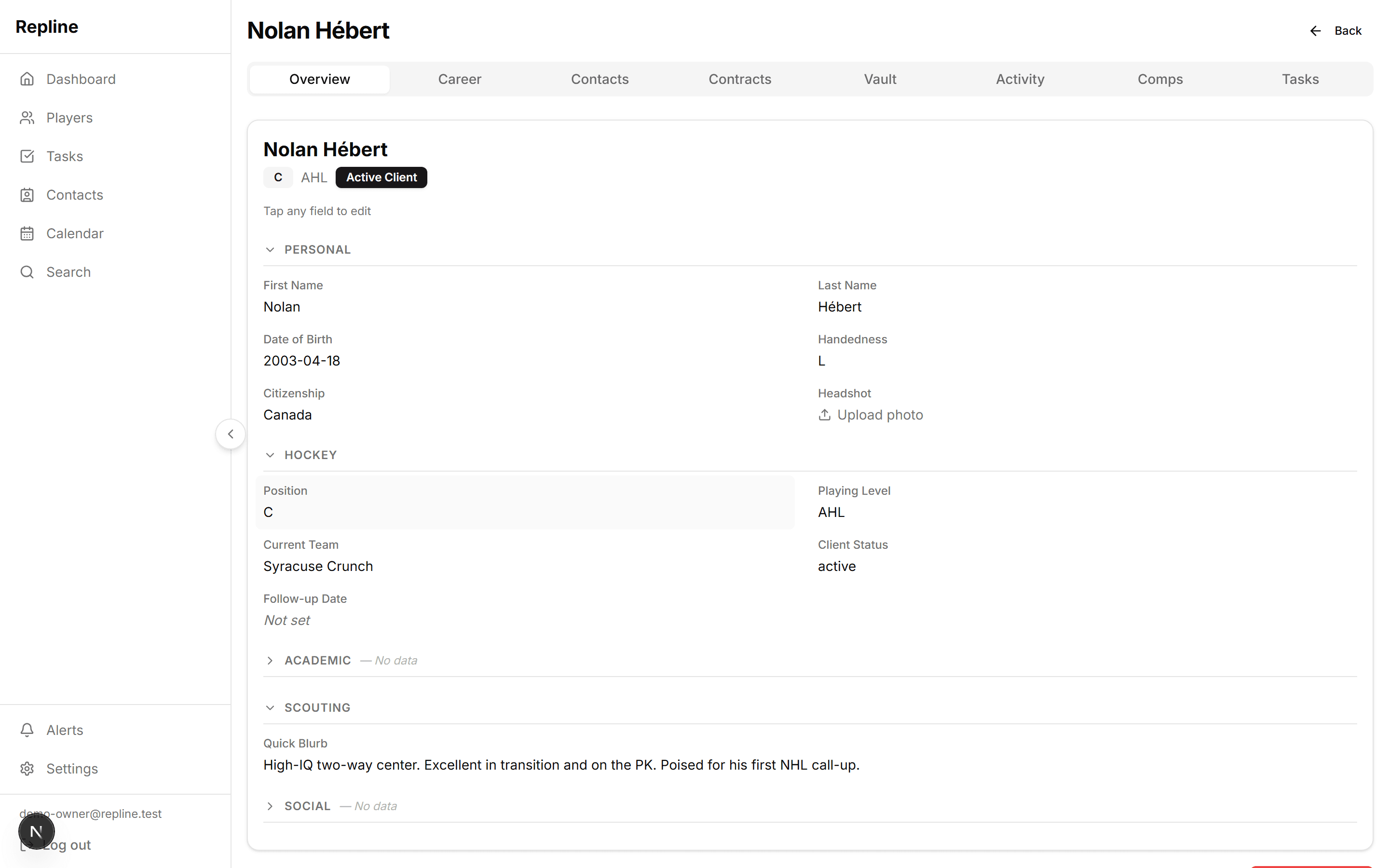
In Repline, notes live on the player's profile alongside their career history, contacts and contracts, and one click turns that profile into a branded player PDF for coaches, GMs and families.
Need a profile to send today? Make one free with our hockey player profile generator.
Frequently asked questions
What should a hockey scouting report include?
Four things. The player's details: name, date of birth, position, handedness, size, team and league. The viewing details: date, opponent, whether you watched live or on video, and how many times you have seen the player. Ratings for each skill area, with a comment explaining every rating. And a summary: strengths, areas to develop, a projection, and a one- or two-sentence blurb someone else can read in ten seconds.
How should you rate players in a scouting report?
Use a short numeric scale, such as 1 to 5, and rate against the level the player is playing at, not against professionals. A 4 for an under-16 player means above average for under-16 hockey. Write down what each number means and use it consistently, so a 3 means the same thing in October as in March, and the same thing from every scout at your agency.
How is a goalie scouting report different?
The player details, viewing details and summary stay the same, but the skill categories change. Instead of skating, puck skills and shot, a goalie report rates positioning, crease movement, puck tracking, rebound control, puck handling and compete. This template includes both sets of categories.
How many times should you watch a player before writing a report?
Write a report after every viewing, but treat a single viewing as a first impression. One game can flatter or hide a player because of the opponent, the score or the player's role that night. Recording the viewing number on each report makes it easy to see whether a rating is based on one game or ten.
Can I download this hockey scouting report template as a PDF?
Yes, free. Use the print button and choose Save as PDF in the print dialog to keep a digital copy, or print a blank scouting sheet to fill in by hand at the rink. There is no sign-up.
Preparing a client for the draft? Our draft day prep checklist for hockey advisors covers when to refresh and send scouting reports.
Every player's notes, history and contacts in one place
Player profiles, scouting notes and branded player PDFs. Free 30-day trial.