How to Become an NHLPA Certified Agent: Requirements
A guide to NHLPA agent certification: eligibility requirements, the application process, exam preparation, fees, and what happens once you're certified.
If you want to represent NHL players, you need to be certified by the National Hockey League Players' Association (NHLPA). There's no shortcut. Unlike some sports where advisors can operate in a gray area, the NHLPA requires formal certification before you can negotiate contracts on behalf of players.
This guide covers the full process — who's eligible, what the application involves, how to prepare for the exam, and what your first year as a certified agent actually looks like.
What Is an NHLPA Certified Agent?
An NHLPA certified agent is a person authorized by the National Hockey League Players' Association to represent players in contract negotiations with NHL teams. Certification is governed by the NHLPA's Regulations Governing Player Agents.
Without certification, you cannot negotiate, or even purport to negotiate, an NHL Standard Player Contract. You also cannot recruit players by holding yourself out as an agent who can handle NHL contract matters.
This is distinct from being a hockey advisor. Advisors can guide players and families on development, career planning, and non-contract matters without NHLPA certification. Many advisors eventually pursue certification as their clients approach NHL-readiness.
Eligibility Requirements
The NHLPA's eligibility requirements are straightforward but non-negotiable:
- Education: You must hold a degree from an accredited four-year college or university. A law degree is not required, but many agents have legal backgrounds.
- Background: You must pass a background check. Criminal history, particularly fraud or financial crimes, can disqualify you.
- No conflicts of interest: You cannot have a financial interest in an NHL team, a related business entity, or any organization that might conflict with representing players' interests.
- Character and fitness: The NHLPA evaluates your overall suitability for the role, including professional references and reputation in the hockey community.
There is no minimum age requirement beyond holding a four-year degree. There is also no requirement that you be based in the United States or Canada, though the practical realities of the business favor North American-based agents.
The Application Process
Step 1: Submit the Application
On sourcing. The NHLPA does not publish a detailed public breakdown of its certification process. The steps below reflect publicly available accounts and should be treated as a guide to what to expect, not as the official requirements. Confirm every detail — fees, exam format, timelines — with the NHLPA before relying on it. Their certified agent listing is the authoritative starting point.
Contact the NHLPA directly to request the application package. The application requires:
- Personal and professional background information
- Educational transcripts (official copies)
- Professional references (typically 3-5)
- Disclosure of any disciplinary actions, lawsuits, or criminal matters
- A non-refundable application fee
The NHLPA reviews applications on a rolling basis. There is no specific deadline, but the review process can take several months.
Step 2: Pass the Written Examination
Once your application is approved, you'll be scheduled for the written exam. The exam covers:
- Collective Bargaining Agreement (CBA): Salary cap mechanics, free agency rules, arbitration procedures, entry-level contract structures, and performance bonuses
- NHLPA regulations: Rules governing agent conduct, fee structures, solicitation, and conflicts of interest
- Standard Player Contract: Terms, conditions, and negotiation parameters
- NHL bylaws and league rules: Relevant provisions that affect player contracts and rights
The exam is open-book but time-limited. Knowing where to find answers quickly is as important as memorizing the material. Most successful candidates spend 2-4 weeks studying the CBA in detail.
Step 3: Interview
After passing the exam, you'll complete an in-person or virtual interview with NHLPA staff. This is a character and fitness evaluation — they want to understand your motivations, your understanding of the agent's role, and how you plan to serve players' interests.
Step 4: Certification
If you pass all three steps, the NHLPA issues your certification. You're now authorized to represent players in NHL contract negotiations.
Fees and Costs
The NHLPA charges an application fee and an annual certification fee. Confirm the current amounts with the NHLPA directly — figures circulating online are several years old and we have not been able to verify them against a primary source.
On commission, the range most often quoted publicly is 3-5% of contract value. Treat that as market convention rather than a published rule: the figure appears mainly in commercial training material, and we could not locate a primary NHLPA source stating a maximum fee schedule. If you need to know what you may charge, ask the NHLPA before you quote a number to a client.
Be especially careful with figures you may find attributed to the NHLPA that in fact come from other players' associations — a widely repeated $2,500 application fee and 3% commission cap are NFLPA figures, not NHLPA ones.
Beyond NHLPA fees, the real costs of starting as an agent include:
- Travel: You'll attend games, showcases, combines, and drafts across North America
- Communication: Maintaining relationships with dozens of players, families, coaches, and team executives
- Operations: Managing contracts, compliance deadlines, and player development tracking
- Insurance: Errors and omissions (E&O) insurance is strongly recommended
What Happens After Certification
Getting certified is the beginning, not the destination. Your first year as a certified agent typically involves:
Building relationships before recruiting. Most successful agents spend months or years building trust with families, coaches, and development programs before they sign their first NHL-bound client. The hockey world is small — reputation is everything.
Understanding the business beyond contracts. Contract negotiation is a fraction of the job. Most of your time goes to player development guidance, career planning, family communication, compliance tracking, and relationship management. The agents who succeed are the ones who treat representation as a service business, not a transaction.
Staying compliant. The NHLPA requires ongoing compliance with its regulations. This includes fee disclosures, contract filing requirements, and restrictions on recruiting conduct. Violations can result in suspension or revocation of certification.
Tracking everything. You'll quickly discover that managing player information, contract deadlines, family communications, and compliance requirements is a full-time operational challenge. Most new agents start with spreadsheets and outgrow them within their first season.
NHLPA Certification vs. Working as a Hockey Advisor
Not everyone who works in player representation needs NHLPA certification. The distinction matters:
| NHLPA Certified Agent | Hockey Advisor | |
|---|---|---|
| Can negotiate NHL contracts | Yes | No |
| Can advise on career development | Yes | Yes |
| Can manage player relationships | Yes | Yes |
| NHLPA exam required | Yes | No |
| Can represent junior/college players | Yes | Yes |
| Typical client base | NHL-ready players | Development-stage players |
Many professionals start as advisors — guiding players through junior hockey, the NCAA, and development leagues — and pursue NHLPA certification when their clients approach NHL readiness. This path lets you build relationships and a track record before taking on the regulatory requirements of full agent status.
Tools for New Agents
Certification gets you the right to represent players; it doesn't get you players. That's a separate discipline — see how hockey agents and advisors actually find and sign new clients.
Managing your first clients with spreadsheets and text threads works temporarily. But as your roster grows, you'll need systems for tracking player profiles, contract deadlines, compliance dates, family communications, and career timelines.
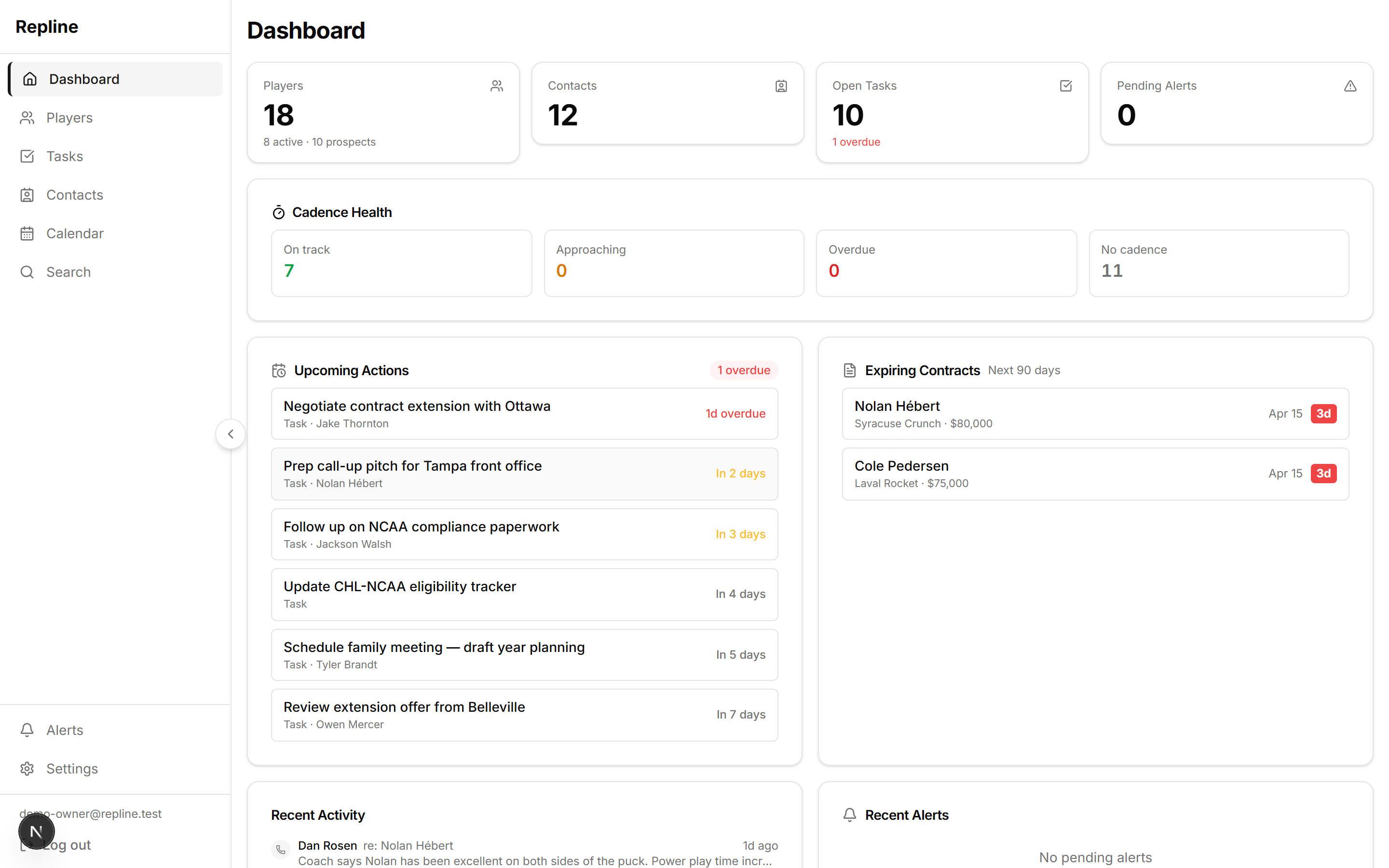
Purpose-built hockey agent CRM software like Repline is designed for exactly this workflow — player pipelines, contact cadence tracking, scouting reports, and agency oversight in one platform. Most agents find they need dedicated tools within their first year of active practice.
FAQ
Do you need a law degree to become an NHLPA certified agent? No. A degree from an accredited four-year college or university is required; a law degree is not, though many agents have legal backgrounds. You also need to pass a background check, hold no financial interest in an NHL team or a conflicting business, and satisfy the NHLPA's character and fitness evaluation. There is no minimum age requirement beyond the degree, and no requirement to be based in North America.
How much does NHLPA agent certification cost? The NHLPA charges an application fee and an annual certification fee, and we have not been able to verify the current amounts against a primary source — confirm them with the NHLPA directly before relying on any figure. Be especially careful with numbers circulating online: a widely repeated $2,500 application fee and 3% commission cap are NFLPA figures, not NHLPA ones.
What commission can an NHLPA certified agent charge? The range most often quoted publicly is 3-5% of contract value, but treat that as market convention rather than a published rule. The figure appears mainly in commercial training material, and we could not locate a primary NHLPA source stating a maximum fee schedule. Ask the NHLPA before you quote a number to a client.
What's on the NHLPA agent exam? Principally the Collective Bargaining Agreement — salary cap mechanics, free agency rules, arbitration procedures, entry-level contract structures and performance bonuses — along with the standard player contract and the NHLPA regulations governing agent conduct, fee structures, solicitation and conflicts of interest. The exam is open-book but time-limited, so knowing where to find an answer matters as much as memorizing it. Most successful candidates spend two to four weeks studying the CBA in detail.
Can you work as a hockey advisor without NHLPA certification? Yes. An advisor can advise on career development, manage player relationships, and work with junior and college players without certification. What an advisor cannot do is negotiate an NHL contract — that requires certification, and nothing substitutes for it. Many professionals start as advisors and pursue certification when their clients approach NHL readiness.
Key Takeaways
- NHLPA certification is widely reported to involve a four-year degree, background check, written exam, and interview — confirm the current requirements with the NHLPA
- The exam focuses heavily on the CBA, standard player contract, and agent regulations
- Certification authorizes you to negotiate NHL contracts — nothing else substitutes for it
- Most agents spend months building relationships before signing their first client
- Advisors can operate without certification for non-contract services
- The operational complexity of player representation grows faster than most new agents expect
For more on how agents and advisors manage their day-to-day practice, see our guide on how hockey agents manage their roster.