AHL and ECHL Contract Negotiation for Hockey Agents
AHL and ECHL contract structures, negotiation strategy and workflow for hockey agents and advisors representing minor professional players.
Most hockey agents don't start their careers negotiating NHL deals. They start in the AHL and ECHL — where the contracts are smaller, the margins are tighter, and the volume of work per dollar is significantly higher.
Understanding how minor professional contracts work, what's negotiable, and how to manage the process efficiently is essential for any agent building a practice.
AHL Contract Structures
Standard Player Contract (SPC)
Players signed to an NHL contract who are assigned to the AHL play under the terms of their NHL SPC. Their AHL salary is specified in the contract (typically a two-way deal with separate NHL and AHL salary figures).
As an agent, you negotiated this at the NHL level. Your role in the AHL is monitoring performance, maintaining team relationships, and positioning the player for a call-up.
AHL-Only Contracts
Players signed directly by an AHL team (not on an NHL roster) play under AHL Standard Player Contracts. These are simpler agreements:
- Term: Typically 1 year (single season)
- Salary range: $52,000-$100,000+ depending on experience and demand
- Signing bonuses: Rare but possible for in-demand veterans
- Performance bonuses: Increasingly common — goals, assists, games played thresholds
- Housing: Some teams provide housing stipends; negotiate this explicitly
Key AHL Contract Terms to Negotiate
- Base salary (the floor is set by the CBA; negotiate above it)
- Performance bonuses (goals, assists, games played, All-Star selection)
- Housing allowance or team-provided housing
- Travel and moving expenses
- No-trade or no-move clauses (rare at AHL level but possible for veterans)
- Out clauses for European league opportunities
ECHL Contract Structures
The ECHL operates under its own CBA with different rules:
- Minimum salary: Set annually by the ECHL CBA (approximately $600/week during the season)
- Veteran minimum: Higher floor for players with professional experience
- Term: Almost always single-season
- Housing: Teams are generally required to provide housing or a housing stipend
- Per diem: Road trip meal allowances are CBA-defined
What's Actually Negotiable in the ECHL
The ECHL has less negotiation room than the AHL, but there are still levers:
- Salary above minimum: The gap between minimum and what teams will pay for proven players can be significant
- Performance bonuses: Goals, assists, points milestones
- AHL out clauses: Critical — allows the player to leave for an AHL contract if offered
- European out clauses: Allows departure for European league opportunities
- Playoff bonuses: Per-round or championship bonuses
- Equipment provisions: Some teams provide more than the minimum
The Negotiation Workflow
Phase 1: Preparation (2-4 weeks before negotiation)
Player evaluation:
- Review current season statistics and trajectory
- Compare to similar players at the same position and age
- Identify comparable contracts (what did similar players sign for?)
- Assess the player's market — how many teams have shown interest?
Market research:
- Contact teams you have relationships with to gauge interest
- Understand each team's roster needs and cap situation (AHL teams have salary structures even without a hard cap)
- Identify leverage points — is your player filling a need that's hard to fill elsewhere?
Set expectations with the player:
- Discuss realistic salary ranges based on comparables
- Align on priorities: salary vs. role vs. location vs. development opportunity
- Agree on a walkaway point — the minimum terms they'd accept
Phase 2: Initial Contact and Offers (1-2 weeks)
Reaching out:
- Contact team GMs and assistant GMs with a professional pitch
- Present the player's case: statistics, scouting reports, character references
- Indicate interest level and availability timeline
Managing multiple offers:
- Track every conversation: who said what, when, and what terms were discussed
- Create a comparison matrix: team, salary offered, term, bonuses, housing, role
- Keep all parties informed of timelines without revealing specific competing offers
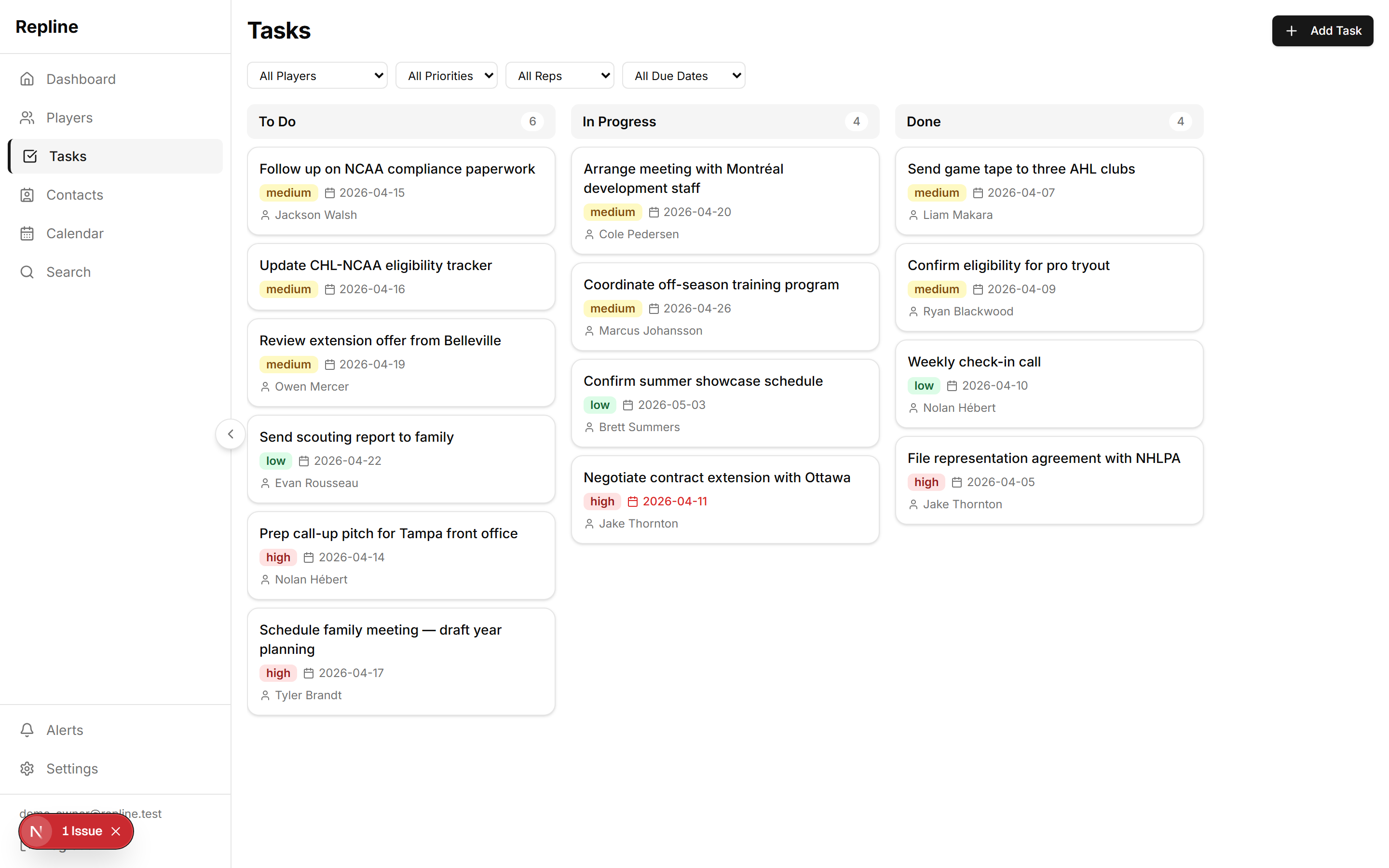
This is where most agents' systems fail. You're juggling 3-5 conversations with different teams for a single player, and you might be doing this for 5-10 players simultaneously. If you're tracking this in your head or in scattered text messages, you will drop something.
Phase 3: Negotiation (days to 1 week)
Closing the deal:
- Negotiate from your strongest offer — use competing interest as leverage
- Focus on the full package, not just salary (bonuses, housing, clauses)
- Get verbal agreements in writing immediately
- Review contract language carefully before the player signs
Common negotiation mistakes:
- Accepting the first offer without exploring the market
- Failing to negotiate performance bonuses (teams will add them if asked)
- Forgetting out clauses (especially ECHL → AHL escape clauses)
- Not confirming housing arrangements in writing
Phase 4: Post-Signing (ongoing)
- File the signed contract with the league within required deadlines
- Update the player's profile with contract details, key dates, and terms
- Set calendar reminders for contract expiration, bonus thresholds, and option dates
- Communicate the outcome to the player's family and support team
- Begin planning for the next contract cycle
Managing Multiple Negotiations Simultaneously
The operational challenge of contract season isn't any single negotiation — it's managing all of them at once. During peak signing periods (July-September for the AHL, August-October for the ECHL), an active agent might have:
- 5-10 clients seeking new contracts
- 3-5 teams involved per client
- 15-50 active conversations to track
- Dozens of offers to compare
- Multiple deadlines to hit
Spreadsheets work for tracking one player's offers. They fall apart when you're running 8 negotiations simultaneously and a GM calls you at 6 PM asking if your player has decided.
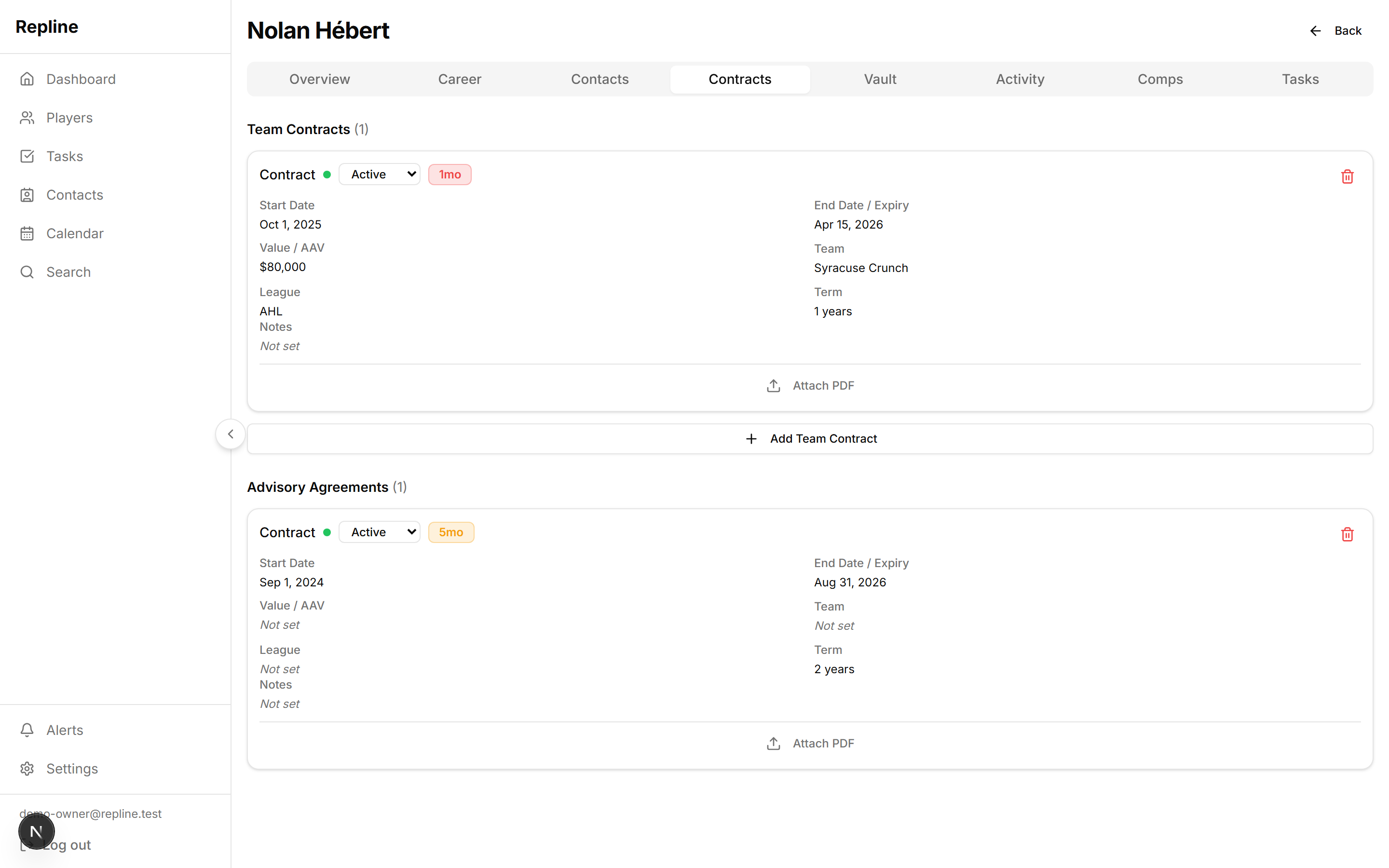
This is where purpose-built tools make a measurable difference. Repline tracks every contract — team deals and advisory agreements — with start dates, expiry dates, value, and status. When a GM calls, you pull up the player's full picture on your phone in seconds.
Comparable Contract Research
Building a case for your player's value requires data. You need to know what similar players signed for — same position, similar age, comparable statistics, equivalent league.
Sources for comparable contract data:
- CapFriendly (NHL/AHL contracts)
- PuckPedia (contract details and cap analysis)
- Elite Prospects (player statistics across leagues)
- League transaction reports (AHL, ECHL official announcements)
- Your own network (other agents will share general market intelligence)
Track your comparable contracts in a structured format so you can pull them up during negotiations. A well-researched comp set turns "I think my player deserves more" into "here are five similar players who signed for 20% above this offer."
FAQ
What's the difference between an AHL-only contract and an NHL two-way deal? A player on an NHL Standard Player Contract who is assigned to the AHL plays under that NHL contract, which specifies separate NHL and AHL salary figures. A player signed directly by an AHL club plays under an AHL Standard Player Contract — a simpler agreement, usually for a single season. In the first case the negotiation already happened at the NHL level, and your job in the AHL is monitoring performance, maintaining team relationships and positioning for a call-up.
What does an AHL-only contract pay? Typically $52,000 to $100,000 or more for a single season, depending on experience and demand. Signing bonuses are rare but possible for in-demand veterans. Performance bonuses tied to goals, assists and games played are increasingly common, and housing stipends are worth negotiating explicitly rather than assuming.
What's actually negotiable in an ECHL contract? Less than in the AHL, but not nothing. The minimum salary is set annually by the ECHL CBA at roughly $600 a week during the season, with a higher floor for players with professional experience, and housing and per diem are largely CBA-defined. The real levers are salary above the minimum for proven players, performance bonuses, and out clauses for AHL or European opportunities.
How long does a minor-pro contract negotiation take? Four phases: preparation two to four weeks before the first conversation, initial contact and offers over one to two weeks, the negotiation itself in days to a week, then ongoing post-signing work. Preparation is the phase that determines the outcome — the comparables you gather before the first call matter more than anything you say during it.
Where do agents find comparable contracts for AHL and ECHL negotiations? PuckPedia for contract details and cap analysis, Elite Prospects for player statistics across leagues, official AHL and ECHL league transaction reports, and your own network, since other agents will share general market intelligence. Track your comps in a structured format so you can pull them up mid-negotiation: a researched comp set turns "I think my player deserves more" into five similar players who signed above the offer on the table.
Key Takeaways
- AHL contracts offer more negotiation room than ECHL — focus on bonuses, housing, and clauses
- ECHL negotiations are tighter but out clauses (AHL, European) are critical to negotiate
- Preparation determines outcomes: know your comparables before the first call
- The operational challenge is managing multiple negotiations simultaneously
- Track every conversation, every offer, and every deadline — the agent who drops a ball during contract season loses clients
- Post-signing work (filing, calendar reminders, family communication) is just as important as the negotiation itself
For more on managing your full practice, see how hockey agents manage their roster or explore Repline's contract management features.