Why Hockey Agents Need a CRM (Not a Spreadsheet)
Spreadsheets, text threads, and memory aren't enough to run a hockey practice. Here's why purpose-built CRM software separates growth from stalling.
Every hockey agent starts the same way: a spreadsheet with player names, a phone full of text threads, and a head full of things they need to remember. It works when you have 5 players. It starts breaking when you have 15. By 30, you're losing track of conversations, missing follow-ups, and spending your Sunday nights manually updating a roster spreadsheet that's already outdated.
The question isn't whether you need better tools. It's when you'll admit that the current system is costing you relationships and clients — and the reasons families actually leave an agent are mostly reasons a better system would have caught.
What a Spreadsheet Can't Do
Spreadsheets are good at storing rows of data. They are terrible at everything else a hockey agent needs:
Real-time shared visibility
In a multi-advisor agency, each rep maintains their own spreadsheet. The managing partner has no idea which players each advisor is actively working, which families have been contacted this month, or which contracts are expiring. Status updates come through hallway conversations and group texts.
A CRM gives every team member access to the same data in real time. The owner sees which reps are active and which are falling behind. Reps see their own roster without stepping on each other's work.
Contact cadence tracking
The most common way hockey agents lose families is silence. You get busy with contract season, forget to call Tyler's parents for three weeks, and the family starts talking to another advisor.
Spreadsheets don't remind you to call anyone. A purpose-built hockey agent CRM tracks your last interaction with every player and every contact, and alerts you when you're falling behind on your cadence — weekly, biweekly, monthly, or quarterly.
Compliance and deadline alerts
Hockey has unique compliance requirements that generic tools can't track:
- NCAA eligibility windows for CHL players
- CHL import draft registration deadlines
- Contract filing deadlines with NHLPA and league offices
- Player agreement expiration dates
- Transfer and waiver period windows
These aren't dates you can set as calendar reminders and forget. They change year to year, vary by league, and the consequences of missing them range from administrative headaches to losing a player's eligibility entirely.
Mobile access at the rink
You're at the rink between periods. A scout approaches you about one of your players. You need to pull up the player's contract status, recent performance notes, and family contact information — right now, standing in a hallway.
Good luck doing that with a 200-row spreadsheet on your phone.
Scouting reports
When a team asks for a player report, you need to generate a professional, branded document — not a copy-paste job from a spreadsheet into a Word template. A CRM with built-in PDF scouting reports lets you generate and send a polished report in seconds.
Why Generic CRMs Don't Work Either
The obvious answer to "I've outgrown my spreadsheet" is a CRM. So you evaluate HubSpot, Salesforce, Monday.com, or Pipedrive. They're all powerful tools. And they're all wrong for hockey representation.
The pipeline mismatch: CRM pipelines are designed for sales: Lead → Qualified → Proposal → Closed Won. Hockey representation pipelines look like: Prospect → Interested → Meeting Scheduled → Committed → Draft Eligible → Signed → Active. You'll spend days configuring a generic CRM to approximate this, and it still won't feel right.
The contact model: CRMs organize around companies and deals. Hockey agents organize around players and families. A player has parents, billets, coaches, scouts, GMs, and academic advisors — all linked in a relationship graph that changes over time. No generic CRM handles this natively.
The feature gaps: Generic CRMs don't generate scouting reports. They don't track league calendars. They don't understand NCAA eligibility rules. They don't send e-signatures for advisory agreements. Every missing feature means another workaround, another tool bolted on, another place for things to fall through the cracks.
The pricing trap: Salesforce starts at $25/user/month and escalates to $150+/user with the features you actually need. HubSpot's useful features start at $100/seat/month. For a 5-person agency, you're looking at $500-750/month for a tool that still doesn't understand hockey.
What a Purpose-Built Hockey Agent CRM Actually Does
Player profiles that make sense
Full player records with hockey-specific fields: position, handedness, playing level, current team, draft year, citizenship, scouting blurb, career timeline. Not generic "deal" records with custom fields bolted on.
A pipeline that matches your workflow
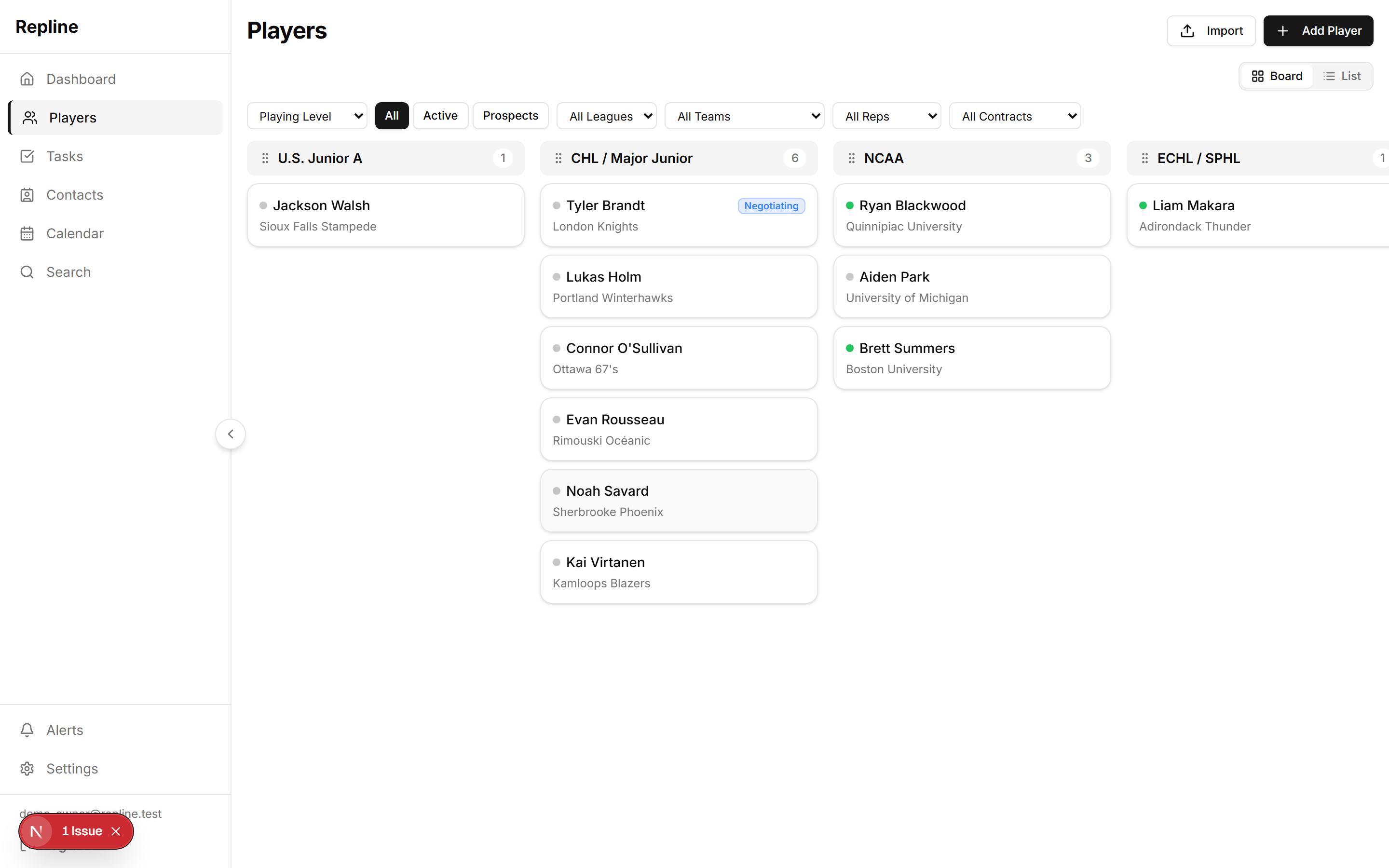
Pipeline stages that reflect how representation actually works: Prospect, Interested, Meeting Scheduled, Committed, Draft Eligible, Signed, Active. No configuration needed. Drag and drop players between stages.
Contact cadence that prevents going cold
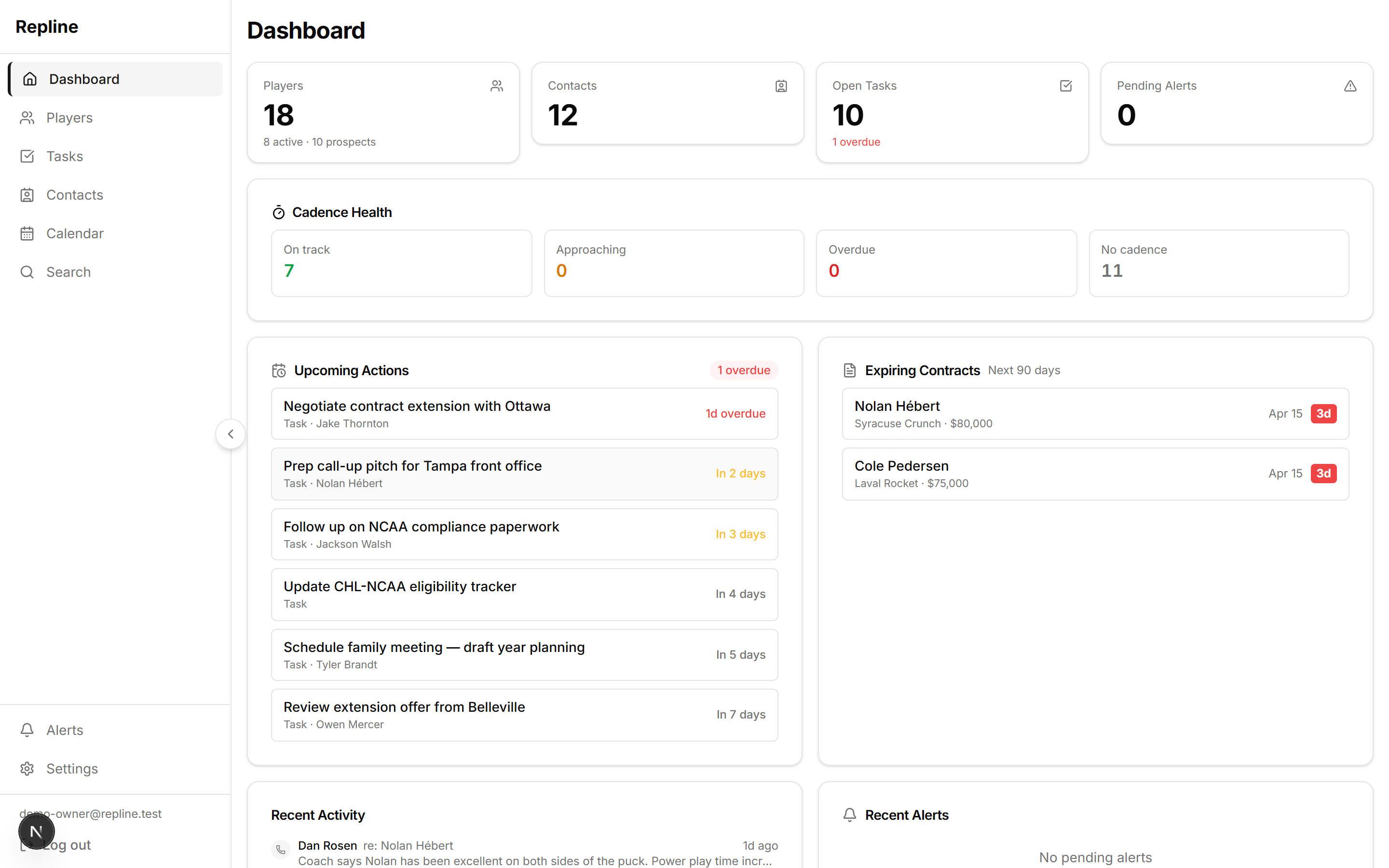
Set a cadence for every player: call this family weekly, check in with that parent monthly. The system tracks your last interaction (call, text, email, in-person meeting) and alerts you before you fall behind. The number one way to lose a family is silence — a CRM makes sure it doesn't happen.
Contract tracking with dates that matter
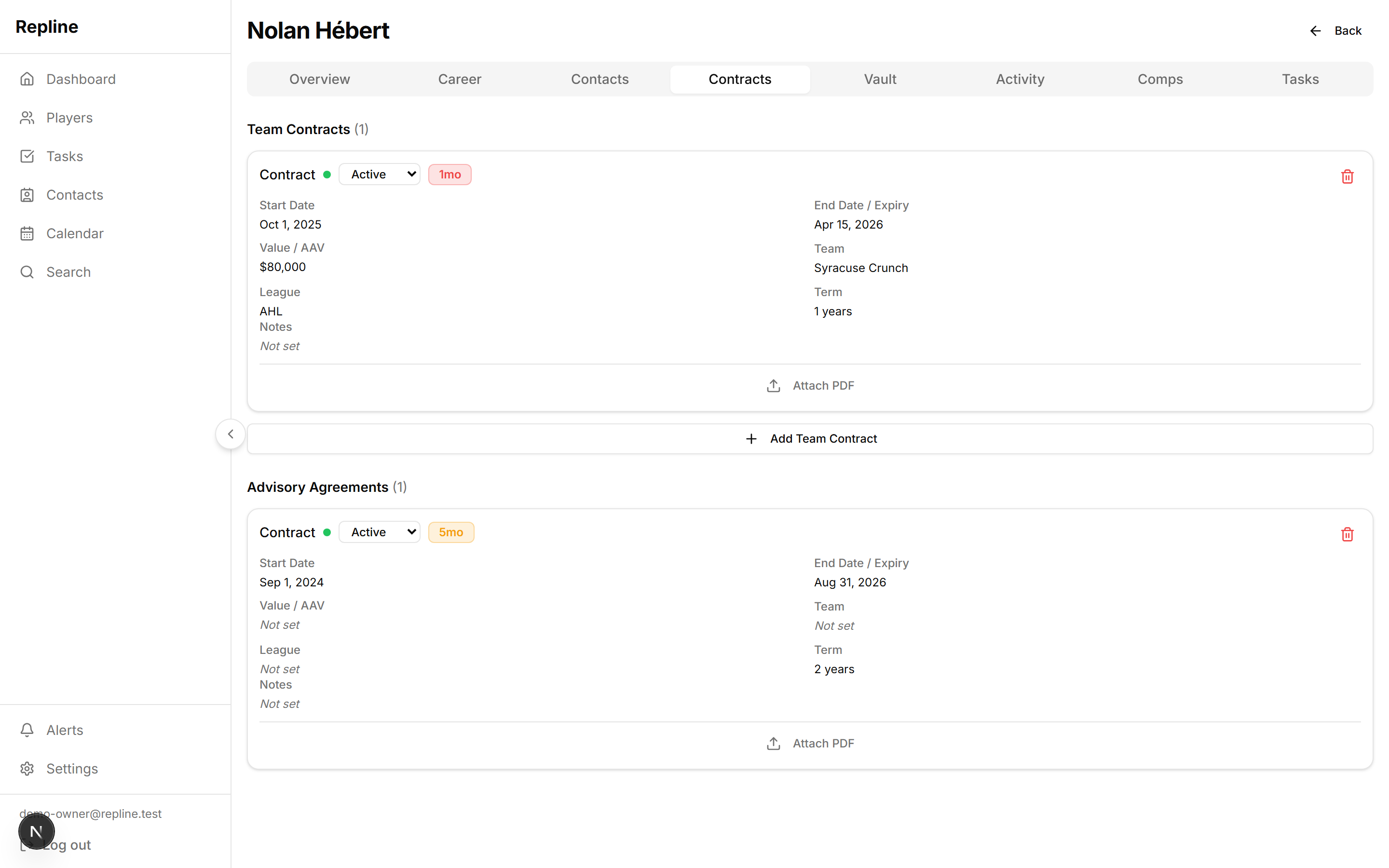
Team contracts and advisory agreements tracked separately, with start dates, expiry dates, value, and status. Auto-calculated expirations generate alerts. E-signatures for advisory agreements sent directly from the contract tab.
Compliance that's built in
League key dates for the OHL, WHL, QMJHL, USHL, NCAA, AHL, and NHL auto-populate in your calendar. Contract expirations generate alerts. Eligibility windows are tracked per player. No more hoping someone remembers to check column M.
Agency oversight for growing practices
When you add a second advisor, you need visibility. A CRM built for hockey agencies gives the owner a bird's-eye view: which reps are active, which players need attention, which families haven't been contacted. Per-advisor rollups show you exactly where your business stands.
Mobile-first design
A CRM that works at the rink isn't a nice-to-have — it's a requirement. Pull up player profiles, log interactions, check contract status, and review your task list from your phone. No app store download required — just a browser.
The Real Cost of Not Having a CRM
The spreadsheet is "free." But what's the actual cost?
- A family that switched advisors because you forgot to call for three weeks: worth more than $75/month
- A compliance deadline you missed because it was buried in a tab: worth more than $75/month
- An hour every Monday manually updating a roster spreadsheet: worth more than $75/month
- A negotiation where you couldn't pull up comparables on your phone: worth more than $75/month
- The managing partner who can't see what their advisors are doing: worth much more than $695/month
The tool pays for itself the first time it prevents a dropped ball.
When to Make the Switch
You don't need a CRM when you have 3 players and work solo. You do need one when:
- You have more than 10 players in various pipeline stages
- You've forgotten to follow up with a family at least once
- You have (or plan to have) a second advisor
- You're tracking compliance deadlines manually
- You've ever said "I should write that down" and didn't
- Your Sunday nights involve updating a spreadsheet
FAQ
Do hockey agents really need a CRM, or is a spreadsheet enough? A spreadsheet is enough while the thing you need to remember is a fact. It stops being enough when the thing you need to remember is a date somebody else set — an NCAA eligibility window, a CHL import draft registration deadline, a contract filing date. A spreadsheet holds that date perfectly and will never once tell you it's coming. If you have fewer than ten players, work alone, and have never been surprised by a deadline, you probably don't need one yet.
Why don't generic CRMs work for hockey agents? Four reasons that compound. The pipeline is built for sales — Lead, Qualified, Proposal, Closed Won — not Prospect, Committed, Draft Eligible, Signed, Active. The contact model organizes around companies and deals rather than players and the parents, billets, coaches, scouts and GMs around them. The feature gaps mean no scouting reports, no league calendars, no eligibility rules and no e-signatures for advisory agreements. And per-seat pricing escalates once you add the features you actually need.
When should a hockey advisor switch from a spreadsheet to a CRM? The practical triggers are more than ten players across different pipeline stages, a second advisor joining or about to, compliance deadlines you are tracking by hand, and the first time you realize you forgot to follow up with a family. If your Sunday nights involve updating a roster spreadsheet, you are past the point.
What can a hockey agent CRM track that a spreadsheet can't? Shared real-time visibility across a multi-advisor agency, contact cadence that tells you which family has gone quiet rather than firing a reminder you set yourself, compliance alerts for rules that change year to year and vary by league, usable mobile access at the rink, and branded PDF scouting reports generated from the player record.
How much does CRM software for hockey agents cost? Repline is $75/month for a solo advisor on Pro (30 players, 1 user), $249/month on Team (75 players, 5 users), and $695/month on Agency (200 players, 15 users). Annual billing saves 15% on Pro and Team and 16% on Agency. Every plan starts with a free 30-day trial and no credit card.
Getting Started
Repline is purpose-built CRM software for hockey agents and advisors. Hockey-native pipeline stages, contact cadence tracking, contract management, scouting reports, and agency oversight — all in one platform. It's what we wished existed when we talked to agents struggling with spreadsheets and generic CRMs. If you're weighing the options, we compared the best CRM choices for hockey agents — including the ones that beat us. If you're weighing it against general sports agency management software, that comparison is worth reading first.
- Pro: $75/month for solo advisors — 30 players, 1 user
- Team: $249/month for small agencies — 75 players, 5 users
- Agency: $695/month for larger firms — 200 players, 15 users
- Free trial: 30 days, no credit card required
Start your free trial or see how we compare to your current tools.